You can't dose chemicals correctly if you don't know how many gallons of water you're treating. That's it. That's the whole reason this matters.
We've been servicing pools in Ellis County for nearly twenty years, and the single most common DIY chemistry mistake we see isn't bad math — it's the right math applied to the wrong gallon count. A homeowner thinks they have a 15,000-gallon pool, doses for 15,000, and wonders why their chlorine never holds. Then we measure it and it's actually 22,000.
So before you dose another bag of shock or another jug of acid, get the gallon count right.
What you need
A tape measure. That's it. If your pool has obvious dimensions — length, width, average depth — you don't need anything else. If it's a kidney or a freeform, you'll need to take three or four measurements instead of two, but it still takes about five minutes.
Rectangular pools
Length × Width × Average Depth × 7.5 = gallons.
Average depth is the key. If your shallow end is 3 feet and your deep end is 8 feet, your average depth is 5.5, not 6. (Most pools have a longer shallow-end shelf than they look like they do, so don't just split it down the middle by eye — actually walk the bottom or look at the original drawings.)
A 16 × 32 with an average depth of 5 feet is 19,200 gallons. Round to the nearest 100 and call it 19,200. Don't round up to 20,000 to be safe — overdosing chemicals creates its own problems.
Round pools
Diameter × Diameter × Average Depth × 5.9 = gallons.
A 24-foot round above-ground pool with an average depth of 4 feet is about 13,594 gallons.
Oval pools
Long Diameter × Short Diameter × Average Depth × 5.9 = gallons.
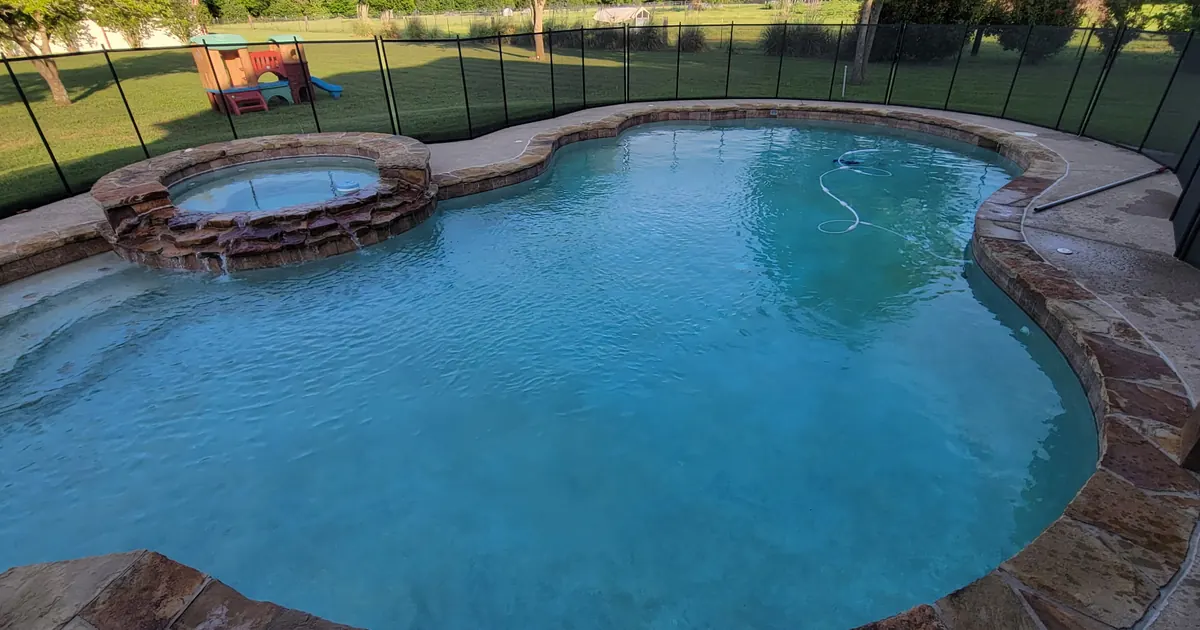
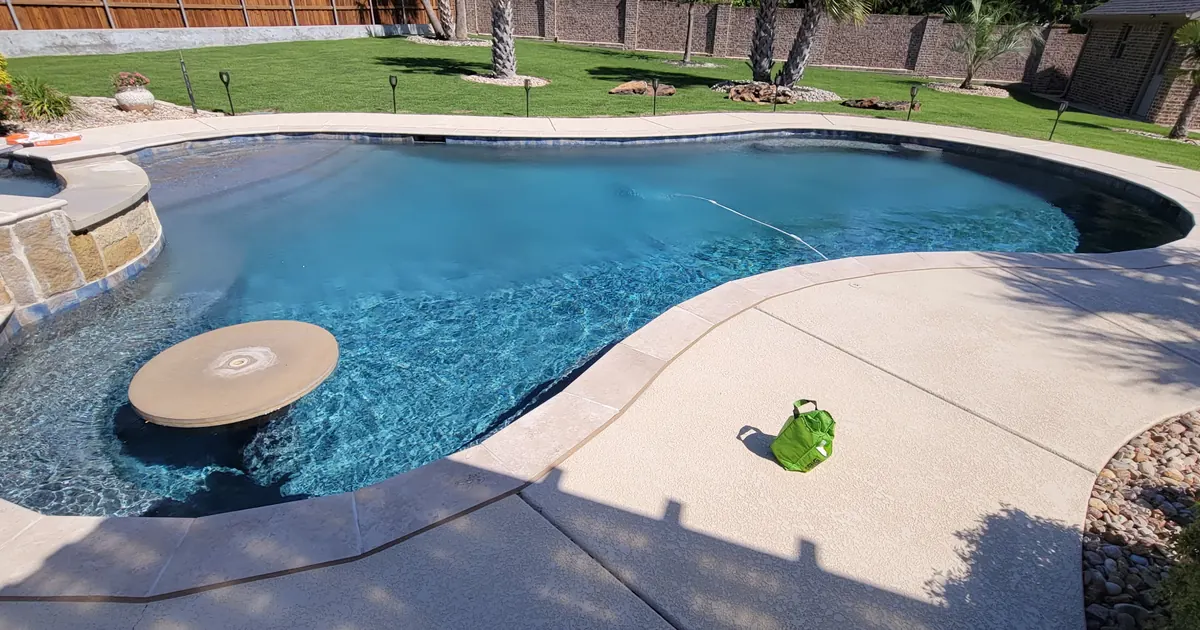
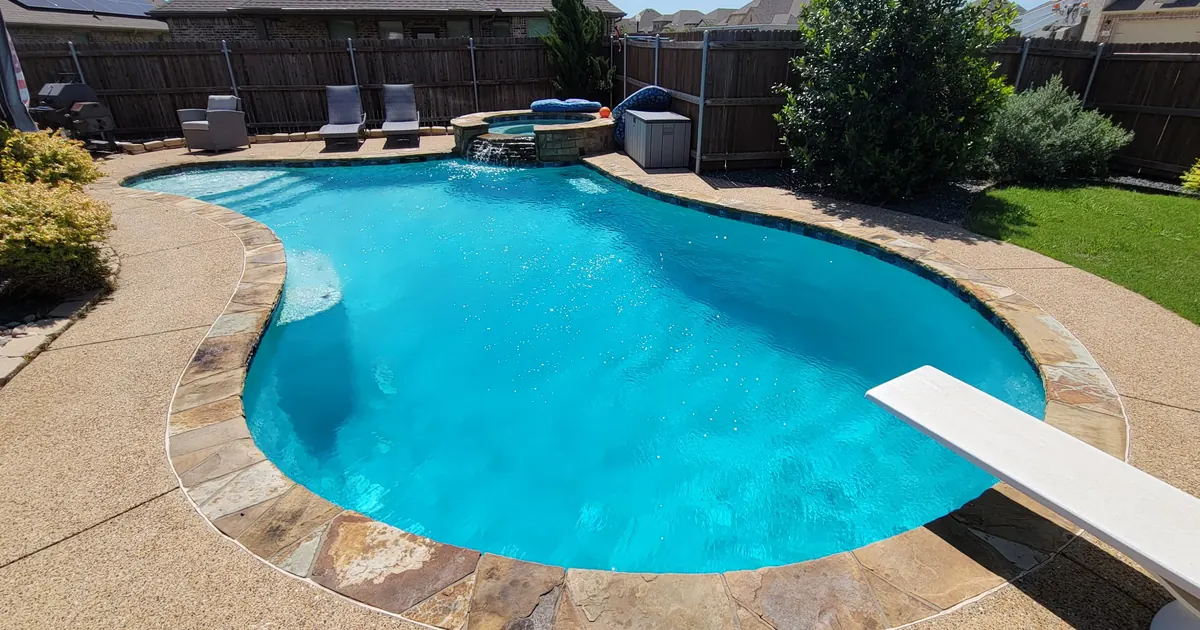
Kidney and freeform pools
This is where most people give up and guess. Don't.
Take an "average length" — sight down the long axis of the pool and estimate the longest distance through the water. Then take an "average width" — eyeball the average width across the pool, not the widest point. Then average depth.
(Average Length × Average Width × Average Depth × 7) = gallons.
The "× 7" instead of "× 7.5" accounts for the curves cutting some volume off the corners. It's a planning estimate, not a survey, but it's close enough for chemistry purposes.
If you have your original construction drawings, even better. The gallon count is usually printed on them. Pull them out before you start guessing.
Vinyl liner pools
If your pool has a hopper-style deep end (a sloped bottom that drops to a flat deep section), you need to do a slightly more careful average-depth calculation. Measure the depth at the shallow end, the depth at the slope start, and the depth at the deep end. Weight by what percentage of the pool is at each depth. It sounds fiddly. It's not — it's the difference between accurate chemistry and chasing your tail all summer.
What to do with the number
Write it down. Put it in your phone notes. We tell every customer to put it on a piece of waterproof tape inside their equipment-pad door so they always have it when they're standing at the pool with a chemical bag in their hand.
Then run it through the Pool Volume Calculator one time to double-check the math. Once you have a confident gallon count, every other calculator on this site — chlorine, muriatic acid, baking soda, salt — will use it automatically.
A quick sanity check
If you're in a typical Ellis County backyard pool, you're probably in the 15,000–25,000 gallon range. Plunge pools and small spool pools run 6,000–12,000. Big pools — long lap pools or pools with attached spas — run 25,000–40,000.
If your number falls way outside what looks normal for your pool's footprint, remeasure. It's almost always an average-depth error.
When to just have us do it
Honest answer: if you've owned the pool for years and your chemistry has been off the whole time, the problem might not be the gallon count. It might be that your pool is bigger than you think and your stabilizer is too high and your chlorine demand has been climbing for three summers running.
We can pull up to your pool in Waxahachie, Midlothian, Cedar Hill, Ennis, Red Oak, or anywhere else in Ellis County, take a full set of measurements, do a complete water-chemistry panel, and give you a real number on a piece of paper. No upsell. If you just need a measurement and a panel, that's what you'll get.
Run the Pool Volume Calculator or call Thomas directly at (214) 399-7347.